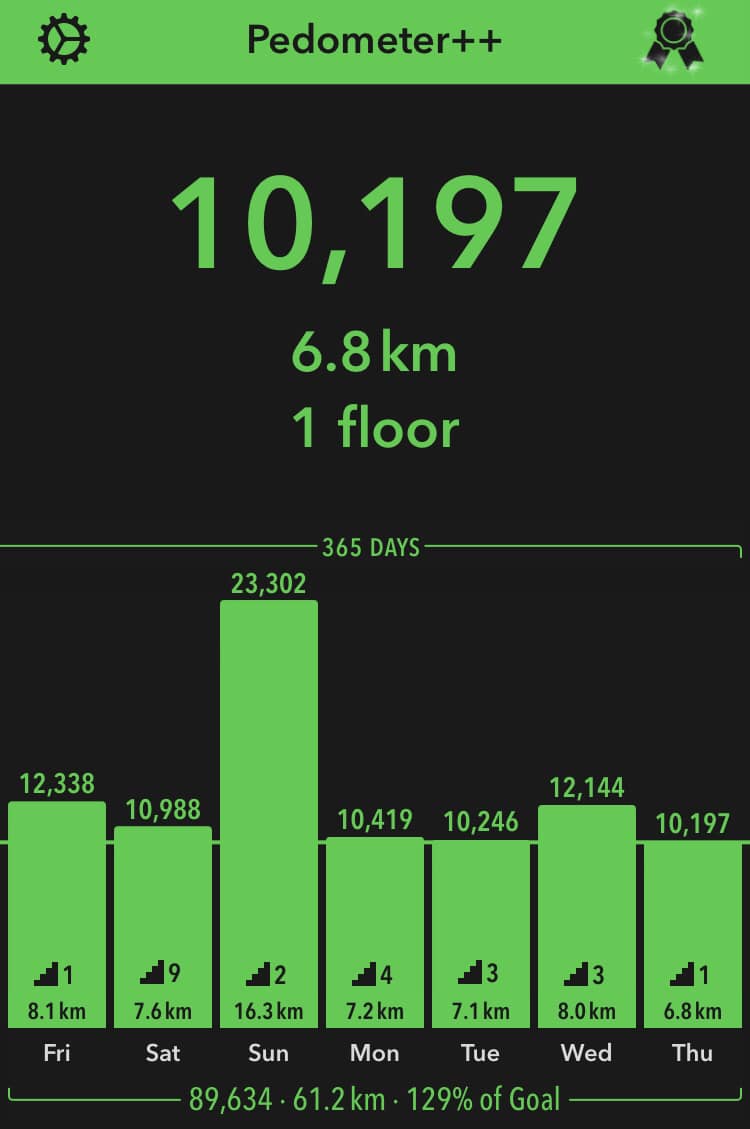
It’s not difficult to walk 10,000 steps in a day. But to walk 10,000 steps a day for 365 days, that’s a whole other story. Here’s what I learned from attaining a 365-day streak of walking 10,000 steps.
In November 2022, I started to walk 10,000 steps daily. It wasn’t because of health reasons, but more for travel reasons.
I worked out that when I travel, I often walk about 10,000 to 15,000 steps when I explore places. But it often left me feeling tired and aching the next day.
So I reasoned that if I conditioned myself to walk at least 10,000 steps every day, I would have no problem with this issue when I travelled. And I intended to do a lot of travelling in 2023.
At first I did this with my girlfriend in the mornings, but she soon stopped because unlike me, she had a full-time job. In addition, she was studying part-time, so she didn’t really have the kind of time I did to walk.
Having the time to walk is a luxury, I later came to realise. Walking is not the most efficient form of exercise. If you wanted to exercise for health reasons, you wouldn’t choose walking if you could do more strenuous exercises, such as running or cycling.
Hence, the first lesson I learned was that your personal motivation, the reason you want to do this, matters a lot.
2023 was also the year I lost 20kg. But early on, I realised that walking doesn’t help me to lose weight. I plateaued in my weight loss just 3 months after I started, even though I still walked 10,000 steps daily. In fact, it was my one constant, so I can confidently say walking doesn’t help me to lose weight.
It may help to keep me from gaining weight, I don’t know because I didn’t measure this, but it definitely isn’t enough by itself to help me lose weight. How I lost nearly 20kg this year is a story for another time, but it’s definitely not by walking alone.
So the second thing I learned is that walking 10,000 steps daily doesn’t help me to lose weight.
It takes a lot of discipline to do something daily. Fortunately, I started to develop this discipline for daily doing things when from 2020 to 2023, I wrote a daily Covid Chronicle for 1,000 days to document my life during the Covid-19 pandemic.
Some days it’s hard, but most days, it becomes a habit, part of my daily routine. This is extremely important in discipline. This is because some days, it takes tremendous willpower to do what you have to do, and having something as part of your daily routine significantly reduces the amount of willpower needed to do it.
So the third thing I learned is that if you want to do something daily, consistently, it’s important to develop it into a habit.
Did I really walk 10,000 steps every single day for 365 days? No, I didn’t. I used an app to keep track of my daily walks. The app has a feature for rest days, which allows one missed day after six consecutive days of activity. To put it another way, I cannot have two missed days within any 7-day period.
This helped a lot to maintain my streak. Not just because rest days are important, but because there were just sometimes when I couldn’t walk.
Some of those days were when I was sick, down with flu. Some of those days were because of an infected toe. Throughout this year, I dealt with an ingrown toenail. Many times it got infected and it made walking very painful. But still I soldiered on, except for those days when it was just too painful to walk.
Rest days were a precious resource. I used them only if I had to, because I had to make sure that I don’t end up using 2 rest days in the same 7-day period, otherwise my streak would be broken. In the course of 365 days, I took 11 rest days, which is about once a month on average.
So the fourth thing I learned that it’s important to include rest days sparingly.
Related to that is that there is incredible motivation behind not wanting to break a streak. It’s like, I’ve maintained this streak for so long, I just need to do what I have been doing to maintain it one more day.
This desire not to have my streak broken helped very much in motivating me to keep clocking my 10,000 steps daily.
So the fifth thing I learned is that it’s important to track my progress daily and have an app to count my streak.
Sometimes my ingrown toenail would be very painful and make each step hurt. But so long as I could still keep taking steps, I would, because each step took me closer to my goal. I had to take only 10,000 steps each day.
This was something I learned during my dumpster diving days, when some days my trolley would be so full and heavy that I wondered if I could ever reach home.
I learned that if I could walk even just 5 steps before resting, I could make it home eventually. It was just a matter of time. This has been a lesson I continue to apply in many areas in my life, including drawing.
So the sixth thing I learned was a reminder that slowly, but surely, I can reach my goal.
I experimented a lot during my walks. I found out that it takes me 15 minutes to walk 1,500 steps, which multiplied by my stride of 67cm equals 1km.
This makes my walking speed 4km/h on average. Sometimes it’s faster if there are fewer traffic junctions, but this is a good average for mental calculations. Based on this, I need to walk around 6.5km a day to reach my 10,000 steps, and this takes me around 1.5 hours.
This is important in planning my walks, particularly when I’m overseas, but just generally when I’m not walking my usual route. It was also how I developed my usual walking route. Everyday, when I don’t have other plans, I walk from my place to my girlfriend’s house and back. The route is almost exactly 10,000 steps.
I like this route because it has only one traffic junction to cross. I don’t like traffic junctions because the waiting time disrupts my momentum.
So the seventh thing I learned was to know my walking speed, as this helps me to plan where to walk to.
Living in a tropical country means that rain can come quite unexpectedly. Walking 10,000 steps takes about 2 hours, which is more than enough time for rain clouds to unleash their contents on you during your walk, even if the sky was cloudless at the point when you started your walk. I learned this the hard way.
Hence, it’s always good to carry an umbrella around with you, even if it only rains a few times on your walks. In addition, it helps to carry a big umbrella rather than a small one. Small umbrellas only help you to reach shelter, whereas big umbrellas make it possible for you to continue walking in the rain, if you so choose to.
There’s another advantage to carrying a big umbrella around with you, especially if you’re walking overseas or in secluded areas. Big umbrellas can double up as a defensive weapon against wild animals such as stray dogs and monkeys.
So the eighth thing I learned was to carry a big umbrella to protect myself from the elements of nature.
When I first started walking daily, it was at the start of the monsoon season. The weather during this time of the year is predictable. It’s usually hot and sunny in the morning and early afternoon, and then there is often a thunderstorm in the late afternoon or evening. The thunderstorm makes walking very difficult, if not impossible. This left me with walking in the late evening.
However, when I walk in the late evening, it makes it difficult for me to go to sleep early. Sometimes, by late evening, I’m feeling quite tired, and the willpower needed to go for that 2-hour walk can sometimes be tremendous.
The trick I learned, especially in the first few months of building this habit, is to get it done first thing in the morning when I wake up. For a period of time, I was waking up before the sun rose, and getting my walks done by the time the sun came up. The benefits of these are many, such as, starting the day on a good note, as well as having lots of time in the morning to get things done.
However, there are also some downsides to this, particularly the need to sleep early at night in order to wake up early the next morning. This can and does affect my social life.
So the ninth thing I learned was to get my walking done as early as possible in the day.
Nowadays I don’t wake up early to walk anymore. Instead, what I do is to build the walking into my daily schedule as much as possible. If I have to go somewhere, I would walk there and back. It’s not that much more time if the destination is within an hour’s walk. You see, if I’m going someplace by bus that usually takes me 30 minutes to get there (including waiting time), I can walk there in 60 minutes, which isn’t that much more time.
On days that I don’t have a particular destination, I bring surplus food to my friends who live around 5,000 steps away from me. I walk there and back. This helps me to clear the food that I have too much of, makes my friends happy to get free food, and allows me to clock my daily 10,000 steps. Win-win-win!
So the tenth thing I learned was to build my walking into my daily schedule as much as possible.
There is one more thing I learned, but is optional for me. That is to bring along a face towel and water bottle. I do this only if the weather is really hot that day, or I expect to be walking further than 10,000 steps. If not, these are extra weights to carry along which I would rather not. Walking for 2 hours usually doesn’t require hydration if I’m sufficiently hydrated before the walk, but it is very helpful for those longer walks.
The two main things I gained from this one-year experience of walking is, first, the realisation that consistency in small things is really a game-changer for making my life better in every possible way. The second is that these 2 hours of walking daily gives me a lot of time to spend inside my own head, where I do my thinking and problem solving.
I have mentally created many interesting concepts, structures, systems, and solved many problems just by thinking about them when I was walking. It is now my answer whenever I am faced with a problem. Go for a nice, long walk, I tell myself, and when I get back, I almost always have found the answer. If not, then I wait for the next day to walk and think about it again. Some problems require multi days of walking and thinking to solve.
Some days, especially after a long and hard day of mental work, I go for the walks as a way to clear my head and not have to think of anything for 2 hours. That’s nice too.
So there you have it — 10 things that I learned from walking 10,000 steps daily. It started as an experiment, a curiosity. Over time, it’s become my daily habit, and I have gained lots from this experience. If you haven’t done so yet, give it a try for yourself and see if it works for you!
 Daniel Tay