There are few visitors to Kluang. It’s not a bustling city like Melaka, Johor Bahru, or Penang.
Young people here, after finishing school, go to work in other cities, or in Singapore, coming home only on the weekends, if at all.
Many of the younger generation migrate, many to Singapore. It is not there are no jobs in Kluang, but that the salary is low and there are brighter opportunity elsewhere.
Of a class of 50 students, maybe 7 or 8 will stay on in Kluang to eke out a living.
Kite is one of them. Born in Kluang, he met his wife Angel, in secondary school where they were classmates. For a while, they lived and worked in other cities such as Kuala Lumpur and Penang, but they returned to settle down in Kluang.
Angel wrote a poignant reflection essay on her quiet life in Kluang here:
I chanced across the article two trips ago, and have been wanting to meet them.
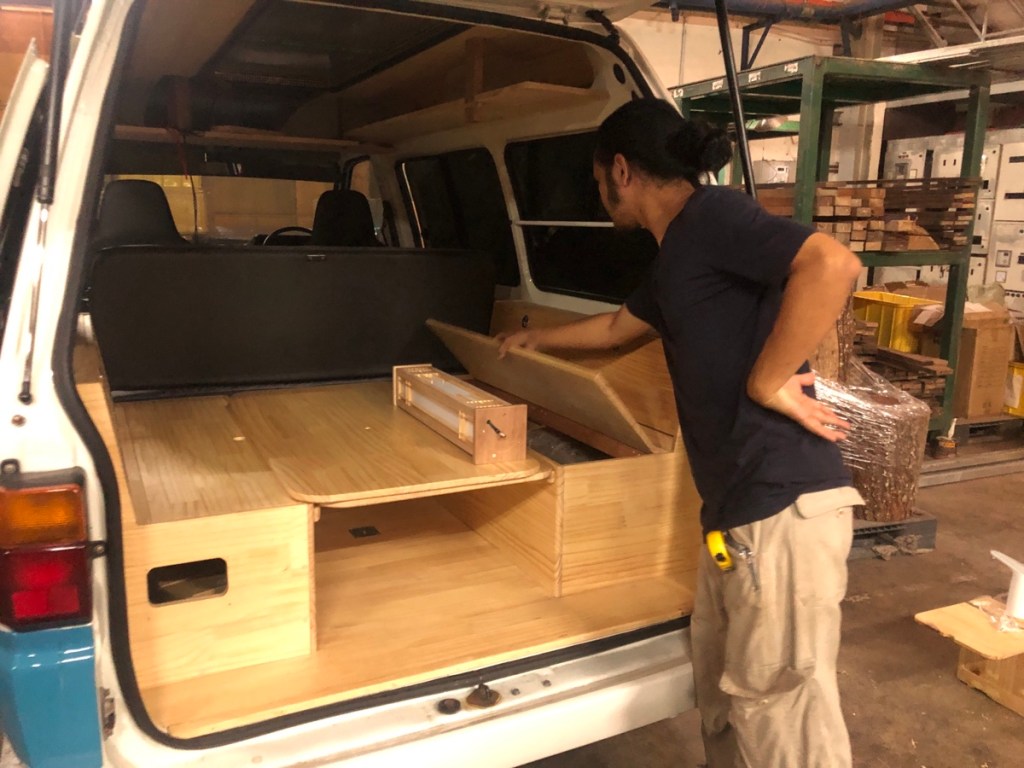
Kite works with wood. He custom builds wooden furniture for his customers. He doesn’t use metal nails or screws as they warp the wood when it expands and contracts as the temperature changes.
I had so many questions. The more I read about them — on the website, and their Facebook pages — the more I wanted to meet them.
They see themselves as an ordinary couple of Malaysians, but the statistics do not lie. They are part of the 15% of young people who choose to settle down in Kluang, instead of living elsewhere.
They are a minority of their generation. Whether they know it or not, every one of these has a story to tell, about why they choose to live in this quiet little town.
=====
There are 5 main attractions in this town:
- Zenxin Organic Farm
- UK Farm
- Gunung Lambak Recreational Forest
- Kluang Television Brand Coffee Factory
- The Original Kluang Rail Coffee
That’s it. Everything else is food. Actually, 4 of the above 5 are already related to food.
Sure, there is the Kluang Street Art as well, but this started only in 2016, and similar projects are present in other towns as well.
The art here draws me though. When I wander the back alleys and study the murals, I feel my own creativity stir from deep within my soul.
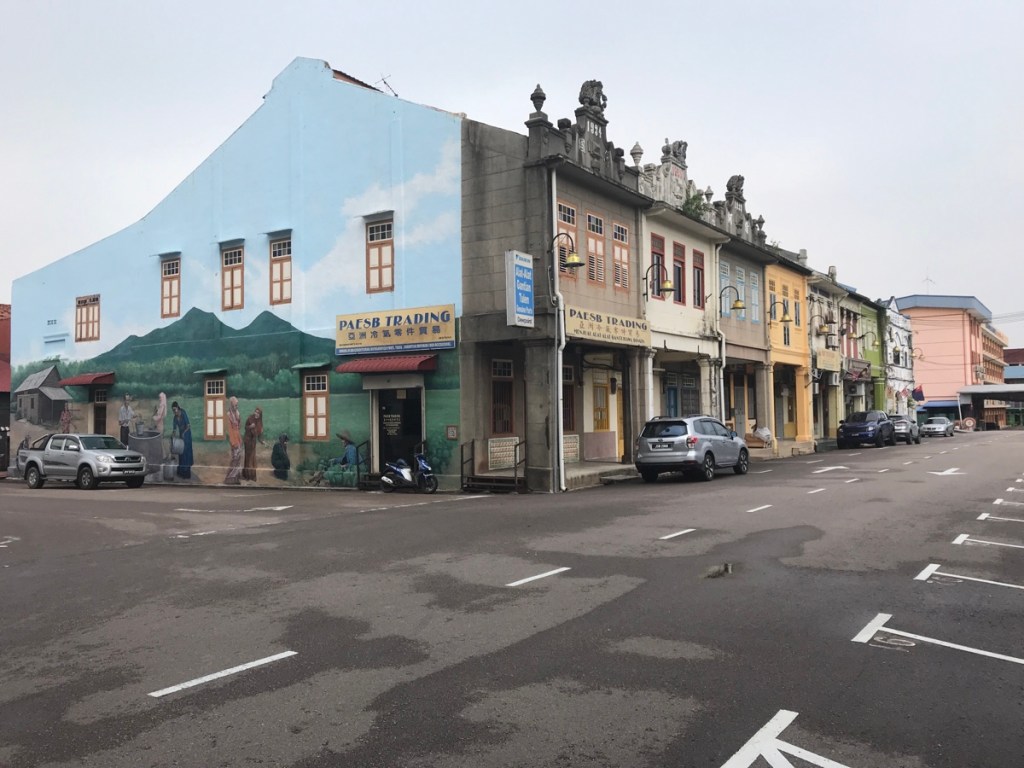
It was here in this town that I discovered my art, buried by years of formal school education, and it is in my repeated visits that I uncover new techniques and breathe life into it.
Kluang produces many creatives. Perhaps it is because there is nothing else to do.
You sit and stare at the mountain, and the mountain stares at you. In boredom, your neurons fire up. Streaks of patterns and colours fill your mind, and you put it down on paper, or canvas, or wood.
We make art because we are bored, or because we want to express ourselves. We make art even if it doesn’t make us a living. It doesn’t have to, because art is life.
Perhaps this is why there are so few artists in Singapore. Perhaps this is why Singapore has so little life, that many of us seek to pleasure and numb our senses with shopping and eating.
Kluang also produces many successful entrepreneurs. These are another form of artists. They are people who think differently. They are people who see the world differently.
You need this to be successful as an entrepreneur. You need to see things that others don’t, and to capitalise on the opportunity you see. You need to be open to experimenting with new things.
=====
People in Kluang are generally open to trying new things. The elderly are no exception.
Kite and Angel have a mobile coffee shop that they sometimes run at events. That is because Kite, before he worked with wood, worked with coffee.
They tell me that at these events, occasionally a senior would come up to them to ask them about their coffee and how much it costs.
A cup of coffee typically sells for RM2 in Kluang coffee shops. So when they tell their customer that their coffee costs RM10, the response they get is usually, “Wah! So expensive! Okay, give me two.”
“That’s the typical Kluang auntie response,” laughs Kite as he relates his most recent encounter.
Perhaps it is because there is nothing to do, nowhere to spend their money, that people in Kluang are so open to trying new things.
There is a growing cafe culture here in Kluang. New cafes have sprouted over the past 5 years, many patronised by those too young to work in other places, and those too old to still be working.
Those too old to still be working are usually split into two camps. One camp speaks primarily Mandarin or dialects, and they tend to congregate in the many coffee shops in the town.
The other camp speaks primarily English, and these are the ones I see hang out in cafes.
I think I have tried more than half of the cafes here already.
=====
Kluang is a nice town for people to retire in. But you probably do need to have your own private transport. Fortunately this is affordable in Malaysia.
Kite tells me that they once bought a secondhand Toyota Harrier for RM30K. The cheapest you can find in Singapore is 8x that price.
A customer he’s built furniture for got their van for RM4K, although the refurbishment did cost about RM10K, not including the woodwork.
The bottom line is that private transport in Kluang is highly affordable, and essential for retiring here, especially if you’re a Malaysian and can buy property as a local.
Landed property here costs about RM300K to RM400K, I’m told. In Singapore you can’t even buy a 2-room HDB flat (45 sqm) for this price.
If you’re Singaporean, you won’t get a chance to buy property here at this price. In Johor, where Kluang is located, the property has to be at least RM1M before you can own it.
=====
Over breakfast, I grill my hosts about their life in Kluang. I ask Kite particularly about his woodwork.
One of his challenges is that customers don’t expect that producing their order takes far longer than they expect. They expect it to take 2-3 weeks, but it sometimes goes up to 6 months.
That’s because Kite is a one-man operation, and very often he has backlog to clear before getting to the latest order.
His workmanship doesn’t come cheap either. A custom-built bookshelf can cost RM4K, while a single wooden spoon can set you back RM100.
You’re assured of quality though. I especially like the finishing on his products, or should I call them artwork? Several times I’ve caught myself caressing the surfaces of furniture in their home.
=====
I spend a lot of time in their home this week. They are hosting me for my 7th trip to Kluang. My stay with them is the highlight.
We have long meals spanning hours, where we feast on simple and delicious home cooked food, or some other tasty food I’ve bought in town and brought back to share.
That’s not all that we share. We also trade stories. I tell stories of food rescue, dumpster diving, and other adventures I’ve had, while they relate stories of their life in a small town, and their travels.
We start in English, as that’s my main language and, over the course of the week, I become more encouraged to speak in Chinese, which is their main language.
Greg, who joins me at their home halfway through the week, catalyses the cross-cultural chemical reaction, and I surprise everyone at my comfortable struggle to use Mandarin.
=====
I spend a lot of time in their beautiful house. There’s plenty of wood here. I have a wooden desk and chair in my room.
Every day, I complete another drawing, honing this skill of mine I discovered right here in Kluang.
I imagine a future, longer trip here, staying with Kite & Angel. I envision buying groceries from a minimart or market, and cooking them over the stove in the kitchen.
One afternoon, I buy 10 eggs, 5 potatoes, 2 red onions, 2 tomatoes for RM10. This feeds me for 2 dinners. Another afternoon, I get some xiao bai cai, a few white onions, and a clove of garlic. I make a simple dinner for me and Greg.
On Greg’s first day here, we visit a night market to get 3 big bunches of longans, and a bag of 9 huge oranges for RM20. The fruits are similar to the quality of fruits we get in our food rescues, definitely reduced to clear. Perfectly fine for us, experienced fruit rescuers.
We finish the longan over two meals. We eat a few oranges and then juice the rest to share with our lovely hosts.
=====
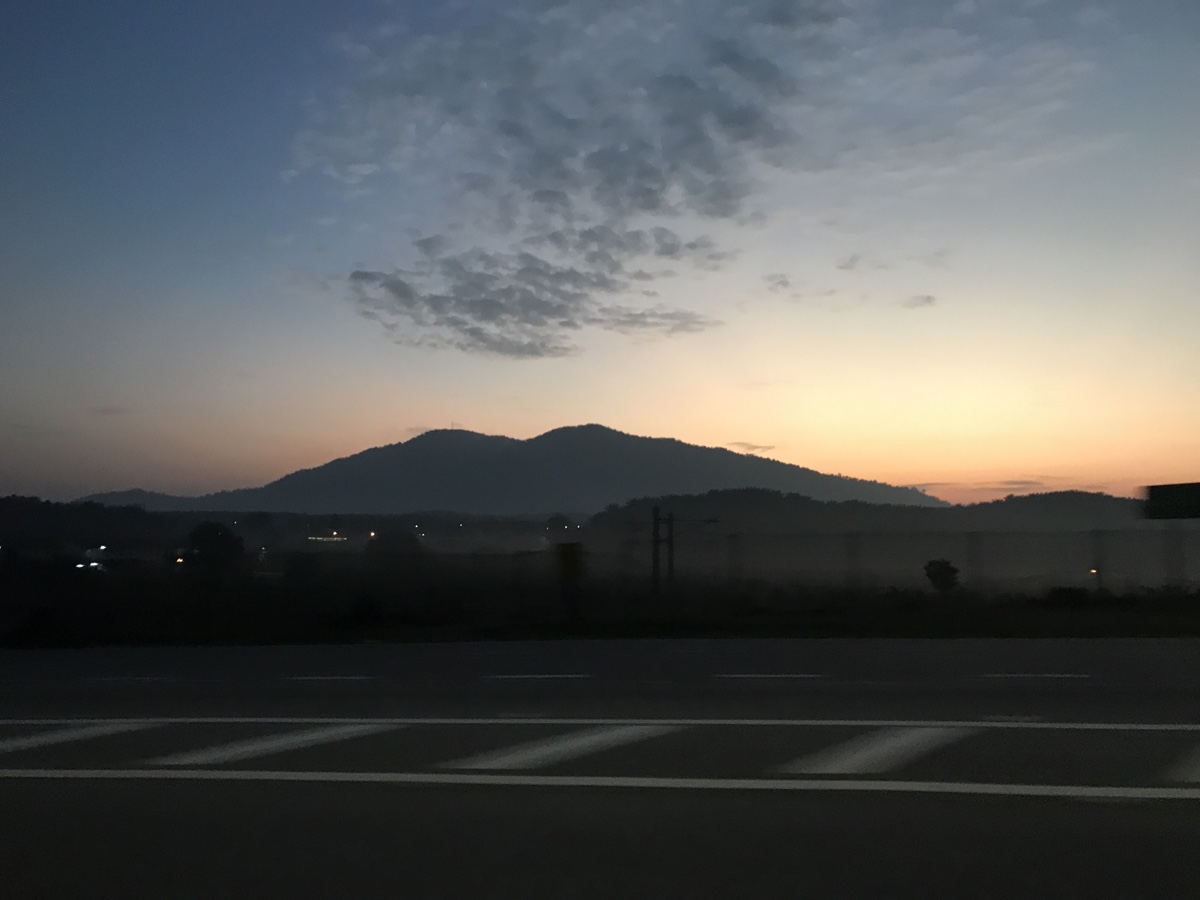
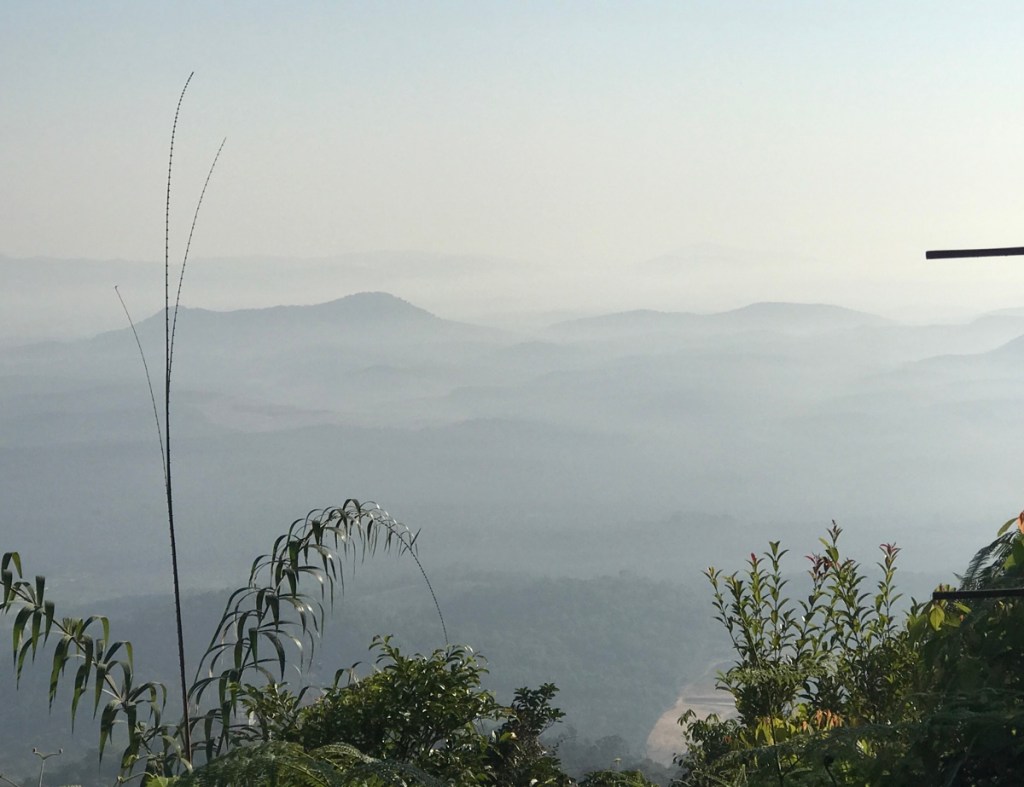
One bunch of longans accompanied us to the peak of Gunung Lambak, the ever-present mountain to the southeast of Kluang.
Long have I wanted to climb this mountain, but I did not want to attempt it alone, lest something happened to me. I could have a fall, or get bothered by monkeys or other wildlife here.
Google Maps reviews tell us that the climb is moderate difficulty. Reviewers regale us with tales of 70-year-old mothers making the climb to the top.
Kite and Angel tell us that it’s not a difficult climb. Other locals tell us that it takes 45 minutes to reach the peak.
I have a word of advice for those attempting it for the first time:
Don’t believe the little shits when they say it’s a moderate climb.
Especially if you are a slow climber like me who hasn’t hiked in more than a year, have zero thigh muscles left, and has to deal with a post-Covid reduced lung capacity.
It’s only a moderate climb for those who can reach the summit of Bukit Timah in 20 minutes.
It takes me 1.5 hours to reach the Gunung Lambak’s 510m peak. I slow down Greg who is 10 years my senior. He periodically stops to wait for me, and plays a game on his mobile phone as he does.
We eat the last of the longans and make our way down the treacherous slope, both our hands tightly gripping ropes that help our descent.
We meet a fellow Singaporean as we tread a gentle slope downwards, with the ropes behind us. He tells us he is here on his day off, and wants to explore beyond Johor Bahru.
He has a sling bag over his shoulder and carries in his hand a plastic bottle of water. We both look at him and think the same thought.
I voice it out, “You’re going to have to find some place to keep that bottle, because a little further, you’re going to need both your hands.”
He looks apprehensively at us.
“Just for a short stretch,” I reassure him.
We part ways and it takes me another 1.5 hours to reach the bottom of the mountain. When I do, my legs are shaking, and my thighs are weak from the strain.
We chill at a nice little cafe at the base. The staff tell us that the cafe is open 4 days a week, over the weekend, because they come from Kulai.
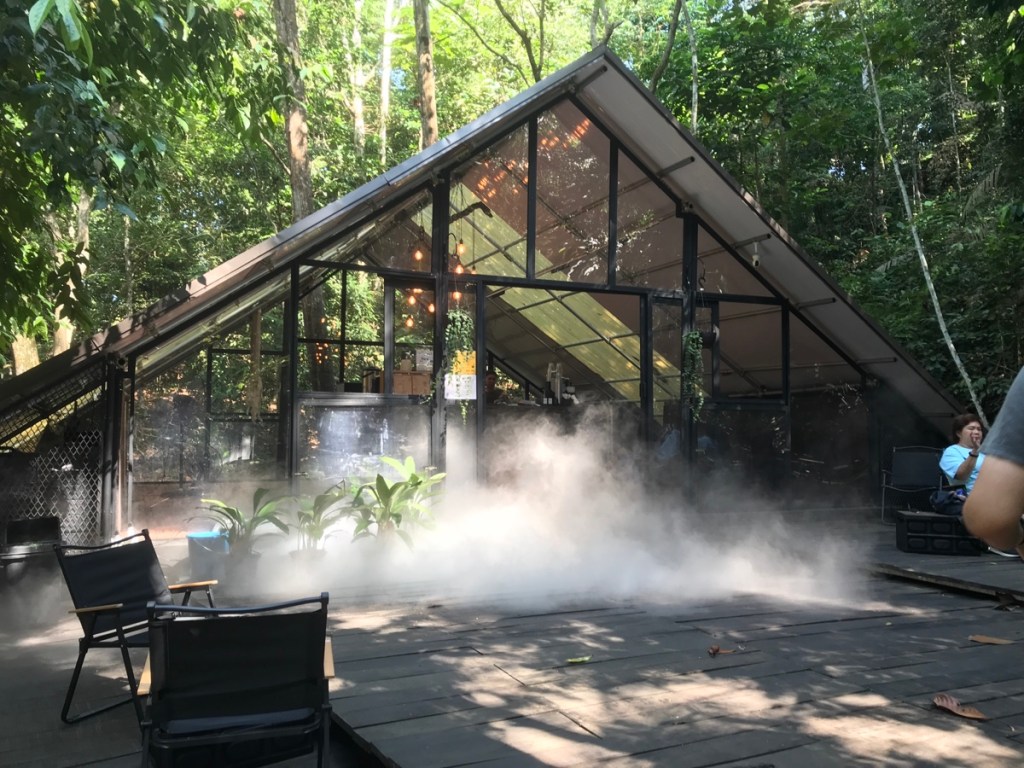
There really are a lot of cafes in Kluang now. It gives the locals something to do, some place to go. And it also brings a few more people to Kluang.
=====
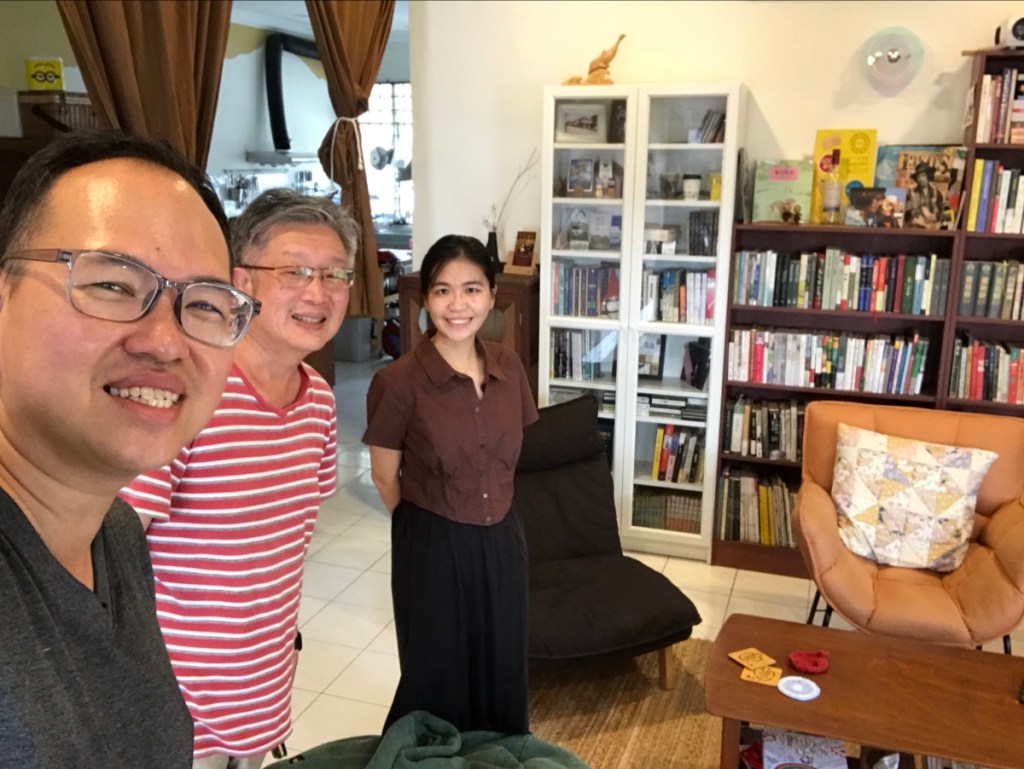
On our last day, we take a photo with Angel, and I regret not taking one with Kite. I have only one of his back, as he shows us his handiwork on a campervan.
It’s okay, I am sure we will get to meet each other again very soon.
There are few visitors to Kluang. It’s not a bustling city like Melaka, Johor Bahru, or Penang. But it has its charm of a quiet life in a small town.
And while there are few visitors, these few visitors frequently come here.
I know I do, and I will soon be back.
 Daniel Tay